A home fire escape plan your family will actually use
A plan drawn once and filed away is not a plan. What works is a sketch on the fridge, two ways out of every room that have actually been opened, a meeting point everyone can name, and two rehearsals a year, one of them in the dark.
Escape planning exists because thinking does not work well in smoke. People wake disoriented, in the dark, in a house whose familiar geometry has become useless, with perhaps two or three minutes of survivable conditions. Under those circumstances nobody solves problems. They execute whatever they have already practised, or they hesitate.
So the plan is not paperwork. It is the process of turning decisions into habits while everyone is calm.
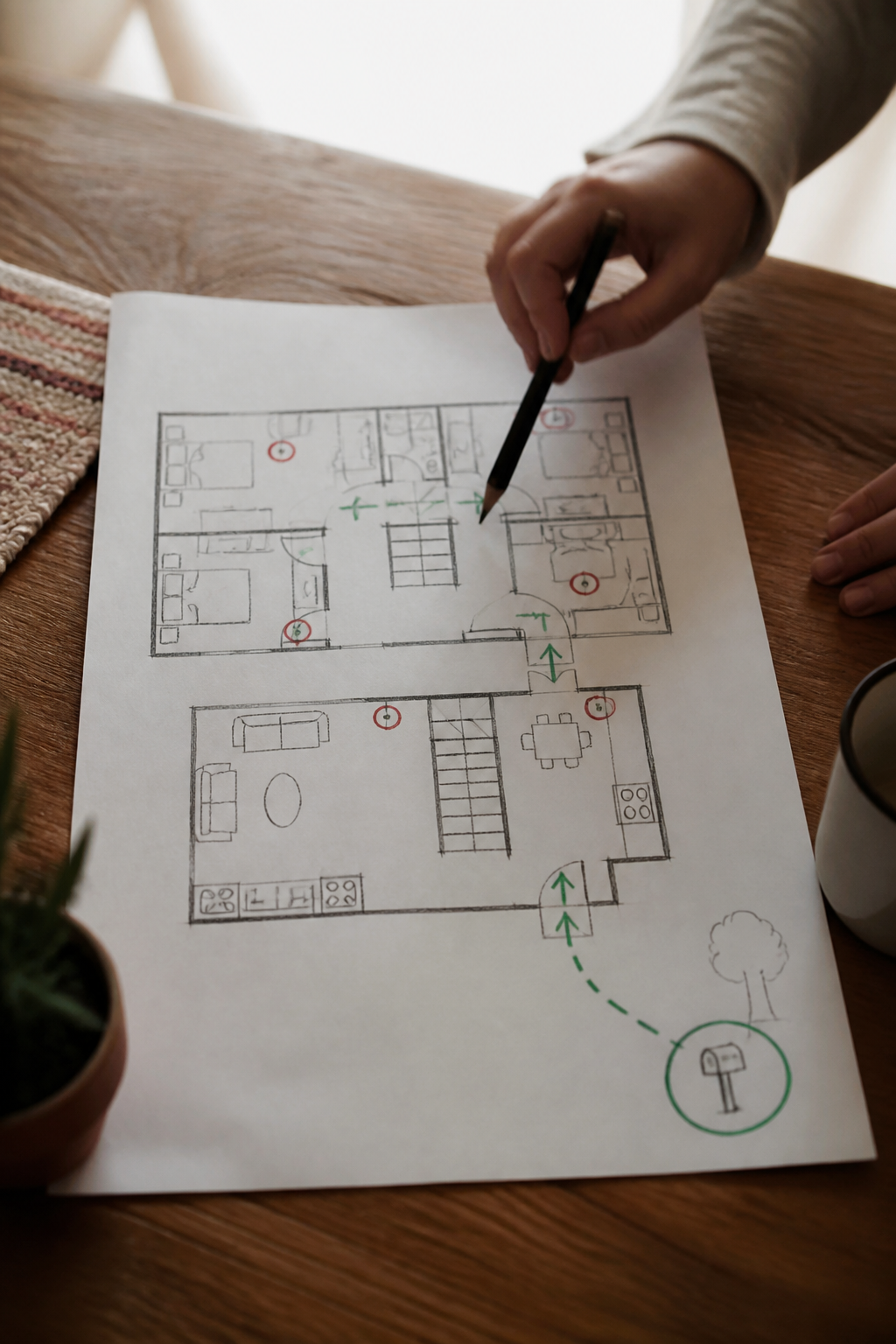
Draw the floor plan
Get a sheet of paper per floor and do it with the children rather than for them. It takes half an hour for a whole house.
- Sketch each floor: rooms, doors, windows, stairs. Accuracy does not matter, completeness does.
- Mark two ways out of every room, and be honest about the second one.
- Mark every smoke alarm and carbon monoxide alarm. Gaps become obvious on paper in a way they never do while walking around.
- Mark the meeting point outside, in front of the house.
- Write the two routes each person takes, from their own bed, in the dark.
- Put it on the fridge. A plan in a drawer is a plan nobody has read.
Two ways out of every room
The first way out is the door. The second is almost always a window, and this is where planning turns into physical work. Go to every window on the escape routes and open it. All the way. Then check:
- Does it open at all, or has it been painted, screwed or nailed shut at some point?
- Can the person who sleeps in that room open it alone, in the dark, without a tool?
- Do the security bars, if any, have an interior quick release that works, and does everyone know where it is?
- Can the screen or the storm window be pushed out or removed quickly?
- Is the drop survivable, and if not, is there an escape ladder in that room?
- Is there furniture, a bed, a cot or stored boxes in front of it?
Fix what you find on the day you find it. A window that needs a chisel is not a second way out; it is a plan that ends at that window.
The meeting point
Pick a fixed object in front of the house that everybody can name and see from the street: the mailbox, a particular tree, the neighbour's driveway, a light pole. Front, not back, so that arriving crews can see you and you are not walking round a burning building to be counted.
Two rules go with it. Everybody goes there, every time, including the person who is sure everyone else is already out. And nobody leaves it, because a search of a burning building for a person who is standing at a friend's house two doors down puts firefighters into a fire for no reason.
The drill
Twice a year, and at least one of them at night. The night drill is the one that teaches the real lesson, because the house is a different place in the dark and children discover that they cannot see the door they know perfectly well.
| Check | Looking for |
|---|---|
| Time from alarm to meeting point | Aim for under two minutes for a whole household, and find out what slows it down |
| Did everybody wake? | Run one drill by actually pressing the alarm while people sleep; deep sleeping children often do not wake to a standard sounder |
| Did anyone stop for anything? | Phones, shoes, pets, a bag. Every stop is a rehearsed habit, so rehearse the right one |
| Did doors get closed on the way out? | A closed door behind you slows the fire down for whoever is still inside |
| Second route | Block the usual stairs with a chair and make everyone use the second way, at least once |
| Who helps whom | Infants, small children, older adults and anyone with limited mobility need a named person, and a named backup |
The rules that do not change
- Get out and stay out. Nobody goes back in for anything or anyone. Tell the fire crew who is missing and where they sleep; they are equipped for it and you are not.
- Check a closed door before opening it with the back of your hand, on the door and then the handle. Hot means use the other way out.
- Close doors behind you as you leave.
- Get low. The cleanest air is near the floor, and the difference between standing and crawling in a smoke filled hallway is enormous.
- Call 911 from outside or from a neighbour's house, not from inside the building.
- Never use a lift in a fire.
Sleeping with bedroom doors closed is the highest value habit in this entire guide. Fire service research burning identical rooms with the door open and closed has repeatedly measured far lower temperatures and dramatically lower carbon monoxide concentrations behind the closed door. It is free, it works while everyone is unconscious, and it buys the minutes the plan depends on.
If you cannot get out
- Close the door between you and the fire, and a second door if there is one.
- Seal the gaps with bedding, towels or clothing, wet if water is to hand.
- Open a window and stay at it. Signal with a torch, a light coloured cloth, anything visible.
- Call 911 and say the address, the room and the floor. Then stay on the line.
- Do not jump from an upper floor. Wait at the window and make yourself visible.
Escape ladder safety for upstairs rooms
A portable escape ladder turns a first floor window into a real second way out. It is also the piece of safety equipment most often bought, stored badly and never once unrolled.
Before you buy
- Storey rating. Ladders are sold by length for a specific storey. A two storey ladder does not become a three storey ladder because you are careful.
- Weight rating. Check the rated working load and the rated total load, and check it against the heaviest person who would use it, plus anyone they might be carrying.
- Standard. Portable escape ladders are covered by ASTM F2175 in the United States. Look for the reference on the label.
- Sill fit. Measure your window sill depth and check the hooks fit it, including over a thick sill, a deep frame or a wide external ledge.
- Stand offs. Rungs held away from the wall by stand off brackets are far easier to climb than a ladder flat against the siding, especially for a child or an older adult.
- Reusable or single use. Some are designed for one deployment. If you want to practise deploying it, buy one you can put back.
Once it is in the house
- Store it in the room it serves, under that window, not in a hall closet on another floor.
- Take it out of the box. A ladder in shrink wrap in the dark is a puzzle nobody can solve.
- Deploy it once, in daylight, from that exact window, so you know how the hooks sit and how far it reaches.
- Practise climbing only from a ground floor window or a low sill, with an adult holding the ladder. Do not have children practise descending from height.
- Decide in advance who goes first. Usually an adult goes down to steady the ladder and receive the others, unless there is a child who cannot be left alone at the window.
- Go down facing the ladder, feet first, one rung at a time, hands on the rungs rather than the sides.
- Check it once a year for corrosion, cuts and damaged rungs, and check that the window it serves still opens.
An escape ladder is a last resort for a room whose only other way out is blocked, not a preferred route. It is not for a third storey unless it is rated and installed for one, not for anyone who cannot climb unaided, and not a substitute for the alarms that would have got everyone down the stairs in the first place.
Who needs help, and from whom
Write names on the plan, not roles.
- Infants and toddlers: a named adult carries them, and a named backup does it if the first adult is not there.
- Deep sleeping children: someone is responsible for waking them, and that person's own route accounts for the detour. Teaching children covers what they can be expected to do alone at each age.
- Anyone deaf or hard of hearing: alarms with a strobe or a bed shaker, and a named person to check.
- Anyone with limited mobility: a ground floor bedroom if it is possible at all, a route without stairs, and a phone within reach of the bed.
- Pets: taken if they come when called on the way out, never searched for. This is a hard rule and it is worth saying out loud to children before the night it matters.
If you live in an apartment building the geometry is different, the building has its own posted policy, and some of these rules change. The renters page covers stairwells, fire doors and what a posted evacuation policy is actually telling you to do.