Fire extinguisher types explained, and the four conditions for using one
An extinguisher is a tool for one narrow situation: a small fire, caught early, with a clear way out behind you. Most of what follows is about recognising that situation, because using the wrong agent or standing in the wrong place turns a manageable fire into an emergency.
Extinguishers are classified by the fuel they are built to put out, and the letters printed on the label are not decoration. Put water on burning cooking oil and the water flashes to steam under the oil, throwing burning fat across the room. Put water on an energised electrical fire and the stream can conduct back to you. The classes exist because these mistakes are common and expensive.
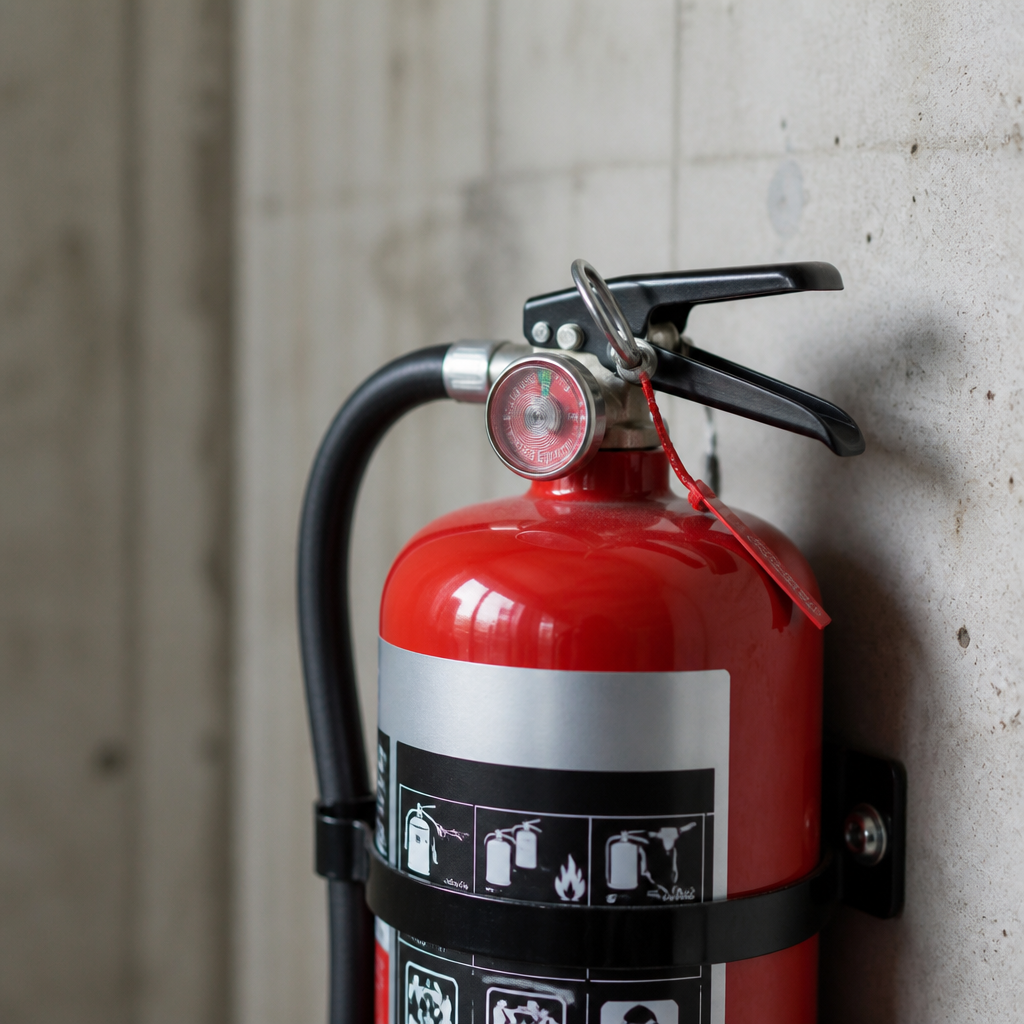
The five classes
- Class A
- Ordinary combustibles: wood, paper, cloth, rubber and most plastics. The everyday household fire.
- Class B
- Flammable liquids and gases: gasoline, paint thinner, solvents, propane. Not cooking oil, which has its own class.
- Class C
- Fires involving energised electrical equipment. The letter says the agent will not conduct electricity back down the stream. Once the power is off, the fire underneath is usually a class A or B fire.
- Class D
- Combustible metals: magnesium, titanium, sodium, lithium metal. Industrial rather than domestic, and the agents are specialised powders. Water makes these fires violently worse.
- Class K
- Cooking oils and fats in commercial kitchens. A wet chemical agent that reacts with the fat to form a soapy crust and smother it. Restaurant kitchens are required to have them; home kitchens rarely do.
| Class | Fuel | Common agent | Where it turns up at home |
|---|---|---|---|
| A | Wood, paper, textiles, plastics | Water, foam, multipurpose dry chemical | Living rooms, bedrooms, waste bins, laundry |
| B | Flammable liquids and gases | Dry chemical, carbon dioxide, foam | Garage, workshop, mower and generator fuel |
| C | Energised electrical equipment | Dry chemical, carbon dioxide | Panels, appliances, chargers, extension leads |
| D | Combustible metals | Specialist dry powder | Almost never in a house; workshops and labs |
| K | Cooking oils and fats | Wet chemical | Commercial kitchens; a lid and a switched off hob at home |
For a house, one multipurpose dry chemical extinguisher marked A:B:C covers the three classes you are realistically going to meet. The trade off is mess: dry chemical is a fine powder that gets into everything and is mildly corrosive to electronics, which is why some people keep a carbon dioxide unit near a workbench full of equipment. Carbon dioxide leaves no residue but has no class A rating worth relying on, so it is a supplement rather than the main extinguisher.
Reading a rating like 2-A:10-B:C
The letters say which fires. The numbers say how much fire.
- The A number is a water equivalence. A 1-A rating corresponds to roughly 1.25 gallons of water in extinguishing capacity, so 2-A is about two and a half gallons' worth.
- The B number is an area. A 10-B rating means an average person with basic training should be able to put out about ten square feet of a flammable liquid fire with it.
- C has no number. It is a statement about the agent, not a quantity: this agent is non conducting and safe to use on live electrical equipment.
A common household unit is around 2-A:10-B:C and weighs about five pounds when charged. Smaller units marked 1-A:10-B:C exist for cars and boats and are genuinely small; they empty in seconds. The bigger question is not the rating but whether the extinguisher is somewhere you can reach in three seconds without moving anything.
The four conditions
Before you pick an extinguisher up, all four of these have to be true. If any one of them is not, the extinguisher stays on the wall and you leave.
- Everyone else is already leaving, and the fire department has been called. Fighting a fire is never the first action, and never the only action happening in the building.
- The fire is small and contained. Roughly, no bigger than a waste bin, still confined to the object where it started, and not spreading up a wall or into a ceiling.
- You have a clear, unobstructed exit at your back. You fight with the way out behind you, never with the fire between you and the door.
- You know this extinguisher. Right class, full gauge, and you have handled one before rather than reading the label for the first time in smoke.
If the extinguisher empties and the fire is not out, or if the smoke is banking down toward you, or if you find yourself thinking about it for more than a moment: leave, close the door behind you, and do not go back in. Rooms fill with smoke faster than people expect, and smoke does the killing long before flame does.
How to actually use one
The technique is remembered as PASS, and the part people get wrong is the aim.
- Pull the pin, breaking the tamper seal. Hold the extinguisher upright and point the nozzle away from your face while you do it.
- Aim low, at the base of the flames, not at the visible fire. Fire burns fuel; you are trying to reach the fuel.
- Squeeze the lever slowly and evenly. Standing back about six to eight feet is normal for a dry chemical unit; move closer as the fire shrinks, never before.
- Sweep side to side across the base until the flames are out, then keep watching. Dry chemical knocks flame down quickly but leaves hot fuel behind, and reignition is common.
Afterwards, back out of the room rather than turning your back on it, and let the fire department confirm the fire is out even if you are certain it is. A rechargeable extinguisher goes to a service company after any use at all, even a one second burst; a disposable one is replaced.
The kitchen fire, which is the one you will actually meet
Cooking causes more home fires than anything else, and almost none of them should be fought with an extinguisher.
- A pan fire: slide a lid or a baking sheet over the pan, turn the heat off, and leave the pan alone until it is completely cold. Do not carry it anywhere.
- Never pour water on burning oil or fat. The water sinks, boils instantly and blows the burning oil out of the pan.
- Do not use flour, sugar or baking powder. Baking soda in quantity can smother a very small grease flare, but the lid is faster and more reliable.
- An oven or microwave fire: keep the door closed and turn the appliance off. Opening the door feeds it air.
- If the fire is out of the pan and onto the wall or the extractor hood, everybody leaves and you call the fire department from outside.
Where extinguishers go
- One on each level of the house, mounted where you can see it from the doorway.
- In the kitchen, near the exit rather than beside the cooker. An extinguisher behind the flames is an extinguisher you cannot have.
- In the garage or workshop, near the door, for the fuel and the electrical work.
- Near heating equipment, wood stoves and any room with a fireplace.
- In the car and the boat, secured so it does not become a projectile.
- Mounted on the bracket that came with it, at a height a smaller adult can lift down, and not on the floor behind boxes.
Checking, recharging, and when to bin it
- Every month: the needle sits in the green, the pin and tamper seal are intact, the hose and nozzle are clear, the body has no dents, rust or leaks, and nothing is stacked in front of it.
- After any use: a rechargeable unit is professionally recharged; a disposable unit is replaced. A partly used extinguisher is not a working extinguisher.
- Every year: rechargeable units get a maintenance check by a qualified service company. This is a requirement in workplaces and good sense at home.
- Service life: disposable household extinguishers commonly carry a manufacturer life of about ten to twelve years, printed on the label. Rechargeables last longer but need periodic hydrostatic testing, which the service company tracks.
- Bin it if the gauge sits in the red or has been repainted, the pull pin is missing, the body is corroded, or you cannot find a listing mark on it at all.
Workplace fire safety basics
Small employers are often surprised to learn that putting an extinguisher on the wall creates an obligation. In United States general industry workplaces, the federal rules run roughly like this, and the current text is worth reading rather than trusting a summary.
| Subject | The gist |
|---|---|
| Extinguisher training | If extinguishers are provided for employees to use, the employer has to give an educational programme on the general principles and the hazards of tackling a fire in its early stage, when someone starts and at least once a year after that |
| Extinguisher inspection | Visual inspection monthly, a maintenance check annually, and records kept |
| Exit routes | Enough of them, unobstructed, unlocked from the inside, adequately lit, marked with signs, and never used for storage |
| Emergency action plan | Written down where required: how the alarm is raised, the evacuation route, the assembly point, who accounts for people, who stays to shut down critical equipment |
| Fire prevention plan | The major fire hazards, how flammable materials are handled and stored, and who maintains the equipment that could cause a fire |
Three practical things sit underneath all of that and are worth doing whatever the rule book says: know your assembly point and go there without being told, never prop a fire door open, and treat a blocked exit as an incident to report on the day rather than a nuisance to walk round. The references page points at the official texts so you can check the current wording yourself.