Heat alarms: the right device for the garage, the attic and the furnace room
There are rooms in most houses where a smoke alarm either goes off constantly or quietly dies, and those rooms are often where a fire starts. A heat alarm is the device built for them. It is a supplement to smoke alarms, never a substitute.
A heat alarm ignores smoke completely. It watches air temperature at the ceiling and sounds when the temperature crosses a threshold or climbs unusually fast. Because it waits for a fire to produce heat rather than smoke, it always responds later than a working smoke alarm would in the same room. That single fact governs everything about where it belongs.
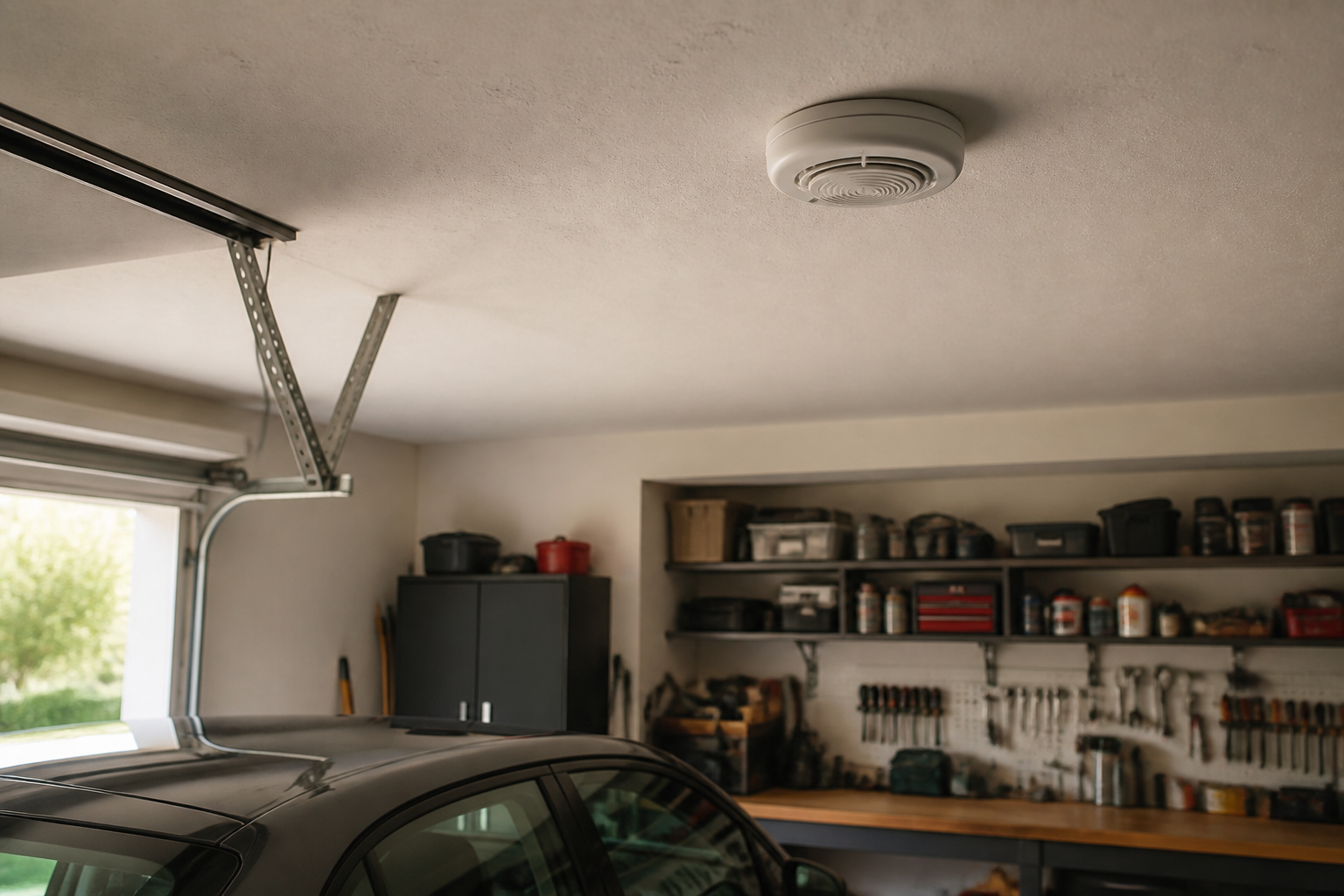
How the two kinds work
- Fixed temperature
- Sounds when the air at the alarm reaches a set point, commonly around 135 °F, on some models 194 °F for very hot spaces such as an attic in summer. Simple, and immune to being fooled by a fast but harmless temperature swing.
- Rate of rise
- Sounds when the temperature climbs faster than a set rate, commonly in the order of 15 °F per minute, regardless of the absolute reading. This catches a fast growing fire well before the fixed set point would be reached.
- Combination
- Both behaviours in one unit, which is what most residential heat alarms sold today actually are. It sounds on whichever condition arrives first.
Rate of rise units do not belong where the temperature legitimately jumps: directly above a shower, next to a garage door that catches full afternoon sun, or immediately over a wood stove. Put a fixed temperature model there instead.
The rooms where a smoke alarm does not belong
Most residential smoke alarms are listed for an operating range of roughly 40 °F to 100 °F in non condensing humidity. Outside that band the manufacturer makes no promises, and the failure is not always noisy. Dust, exhaust fumes, insects and vehicle emissions add their own problems.
| Space | Device | Reason |
|---|---|---|
| Bedrooms, hallways, living rooms, landings | Smoke alarm | Earliest possible warning where people sleep and move |
| Attached garage | Heat alarm | Exhaust, dust and temperature swings would trigger or destroy a smoke alarm |
| Unfinished attic or crawl space | Heat alarm | Far outside the temperature and dust range a smoke alarm is listed for |
| Furnace or boiler room | Heat alarm, plus a carbon monoxide alarm nearby | Combustion by products and dust; the two hazards there are heat and gas |
| Dusty workshop, wood shop, barn | Heat alarm | Airborne dust clogs a smoke sensing chamber within months |
| Kitchen itself | Heat alarm, with smoke alarms outside the room | Cooking aerosols make a smoke alarm in the kitchen unusable, and an unusable alarm gets removed |
A heat alarm never replaces a smoke alarm in a bedroom, a hallway or on a living level. It responds too late to give sleeping people a useful margin. Its job is to cover the rooms where a smoke alarm cannot survive.
Nobody is standing in the garage at two in the morning
This is the part that gets missed. A heat alarm sounding alone in an attached garage is a smoke detector for the raccoons. Its value comes almost entirely from being interconnected with the alarms indoors, so that the garage triggering wakes the whole house.
Wireless interconnected ranges make this straightforward now: choose a heat alarm from the same family as your smoke alarms, pair it, and test the link the same way you test everything else, by holding the button in the garage and listening for the house answering. If the units are hardwired, the heat alarm goes on the same interconnect circuit. A heat alarm that cannot talk to the rest of the house is worth very little.
Fitting one properly
- Mount on the ceiling, near the centre of the space, not on a wall unless the instructions permit it.
- Keep clear of the garage door track, the opener motor and the swing of the door.
- On a peaked ceiling, stay out of the very apex, the same rule that applies to smoke alarms.
- Follow the spacing on the instruction sheet, and use two units in a long or L shaped garage rather than trusting one to cover the whole footprint. Beams and dropped ceilings cut the effective coverage considerably.
- Choose a model rated for the temperature extremes the space actually reaches, which for an attic under a dark roof in summer is higher than most people assume.
- Interconnect it with the indoor alarms, then test the interconnection from the garage.
Upkeep, and what it will not do
A heat alarm has no sensing chamber to clog, which is exactly why it survives in dirty rooms. It still has a battery, an end of life date and a test button, so it joins the monthly round with everything else. Test it with the button only. Never test a heat alarm with a lighter, a heat gun or a hair dryer: you can pass the set point, damage the sensor and void the listing in one move.
Two things it will not do, both worth stating plainly. It will not detect a smouldering fire in its early stage, which is the stage that matters. And it will not detect carbon monoxide, so a garage heat alarm gives you no protection at all from a car or generator running in that garage. That is a separate device with separate placement rules, and in a house with an attached garage it is not optional.