Teaching children fire safety at home, and a childproofing pass through the house
Children do not behave in a fire the way adults expect. They hide from the noise, they hide from the people in masks, and they wait to be told what to do. All three are fixable, and the fix is practice rather than warning.
Two things are true at once. Small children cannot be relied on to save themselves in a fire, which is why every escape plan names an adult for every child. And children who have practised do far better than children who have only been warned, which is why the practice is worth the half hour.
What to teach, and when
| Age | What they can learn | What an adult still does |
|---|---|---|
| 3 to 5 | What the alarm sounds like; matches and lighters are for grown ups; tell a grown up if you find one; do not hide; go outside | Everything else. A named adult carries or leads them out |
| 6 to 9 | Their own two ways out; crawl low; feel a door before opening it; go to the meeting point and stay; how to call 911 from outside | Waking them, and leading if the route is blocked |
| 10 to 12 | Open their own window, use a ladder if the family has one and has practised, close doors behind them, help a younger sibling on the route | Confirming they are out; the plan still names an adult for them |
| 13 and up | The whole plan, including being the named helper for a younger child, and the babysitting version of it | Reviewing the plan together each time it changes |
The lesson that matters most: do not hide
Children hide when they are frightened, and a fire is frightening in three directions at once: the noise, the smoke, and eventually a stranger in a mask with a torch and a breathing apparatus that sounds like a machine. Firefighters routinely find children under beds, in wardrobes and behind sofas.
Two habits fix a great deal of that.
- Practise leaving, not hiding. Run the drill often enough that going to the meeting point is the automatic response to the sound, and praise it every time.
- Meet a firefighter in gear. Fire stations and open days exist partly for this. A child who has seen the mask, heard the breathing and been spoken to through it will move toward that figure rather than away. Ask your local station whether they run visits.
Matches and lighters are tools, not toys
Curiosity fires set by children are a real category, and the pattern behind them is consistent: an unsupervised child, a lighter within reach, a hiding place. The counter is not a lecture.
- Store lighters and matches locked, high up, and out of sight rather than merely out of reach.
- Choose child resistant lighters, remembering that child resistant does not mean child proof.
- Teach a single sentence, at three years old and every year after: if you find a lighter or matches, do not touch, tell a grown up.
- Treat lighter play as a serious signal rather than mischief, and ask your fire department about their youth fire setting programme if it happens more than once. Most departments run one and it is confidential.
- Never use a lighter to entertain a child, and never let one watch you light candles as a treat.
Stop, drop and roll, and when it does not apply
It is for one situation only: clothing on fire. Stop moving, drop to the ground, cover the face with the hands, and roll back and forth until the flames are out. Children love practising it and that is fine, because a rehearsed physical response survives panic.
It is not the answer to smoke, to a fire in the room, or to an alarm sounding. For those, the answer is get low and get out. Teaching both, and naming which is which, avoids the child who drops and rolls in a smoke filled hallway.
Running a drill with young children
- Tell them it is a practice, before you make any noise.
- Use the real alarm sound. A shout of "fire drill" teaches them to respond to your voice, which will not be there.
- Let a child lead one drill and choose the route.
- Do one drill at night, and be ready for the discovery that a child who wakes to the alarm at home may not wake at all. That is worth knowing before it counts.
- Finish at the meeting point with a stopwatch and something cheerful. Fear teaches hiding; competence teaches leaving.
- Practise the phone call outside: full address, and the sentence "there is a fire at my house".
Research on waking effectiveness has consistently found that some children sleep straight through a standard high pitched alarm that wakes every adult in the room. Alarms with a lower frequency sounder, a recorded voice, or a bed shaker wake sleepers more reliably. Until you have one, the plan names the adult who wakes that child, and a backup.
How to childproof a home: a room by room checklist
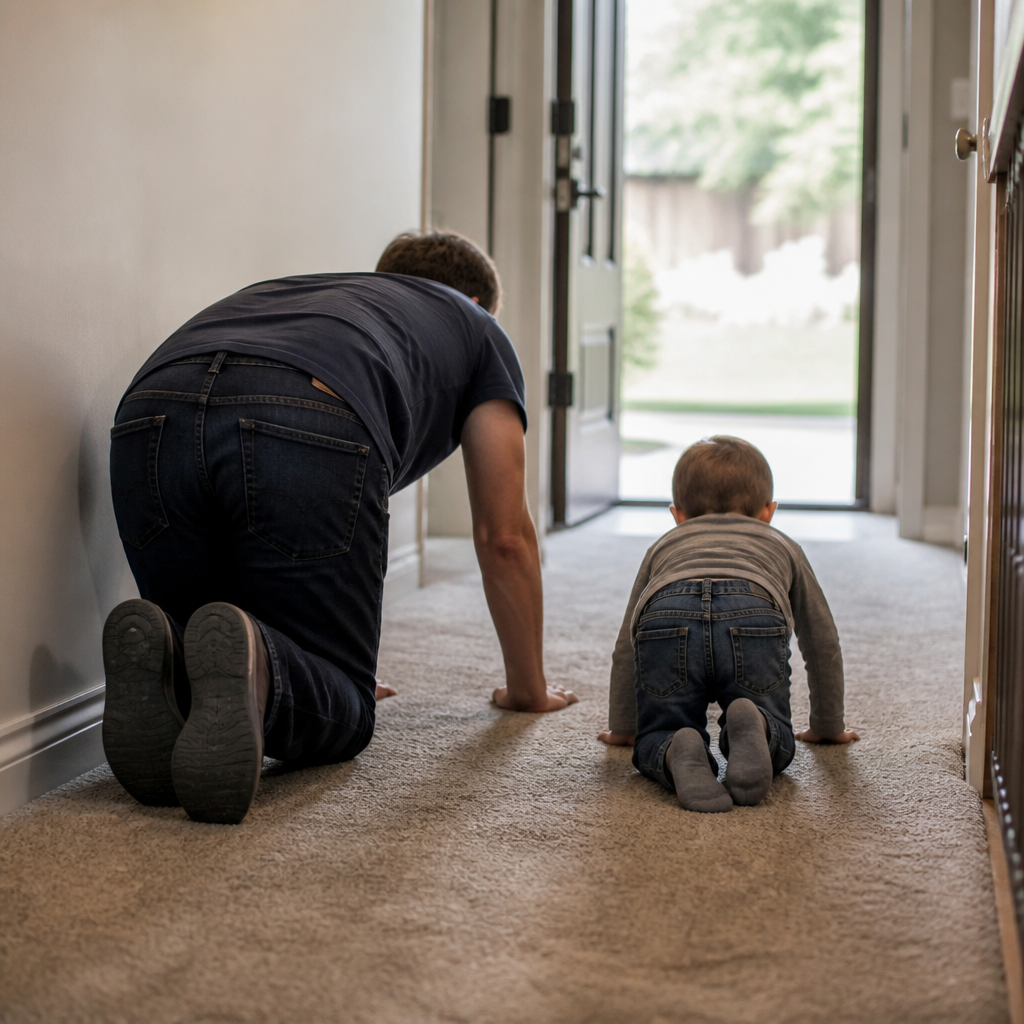
Fire is one hazard among several, and the same walk through the house catches the rest. Do it at the child's height, on your knees, because that is where the hazards are.
Kitchen
- Cook on the back burners, pan handles turned inward.
- A three foot child free zone around the cooker, marked with tape on the floor if that helps.
- Stove knob covers, and an oven door lock if the child is a climber.
- Cleaning chemicals out of the under sink cupboard entirely, or behind a working latch.
- Hot drinks away from table edges and out of reach of a grabbing hand.
- Kettle and appliance cords pushed back, never hanging over an edge.
Bathroom and laundry
- Water heater set to about 120 °F, and bath water tested before the child goes in.
- Medicines and cleaning products high and latched, including handbags left on chairs.
- Never leave a child alone in the bath, not for the length of a phone call.
- Dryer lint trap cleared every load, and the duct cleared yearly.
Living rooms and bedrooms
- Televisions and heavy furniture anchored to the wall. Tip overs injure and kill young children every year, and an anchor kit costs very little.
- Blind and curtain cords cut short, tied up, or replaced with cordless blinds. Looped cords are a strangulation hazard.
- Outlet covers on unused sockets, and extension leads run behind furniture rather than under rugs.
- Portable heaters with three feet clear on every side, never in a child's bedroom overnight, and never on an extension lead.
- Candles out of reach, and out entirely before anyone sleeps. Battery candles in children's rooms.
- Nothing over the cot, and no pillows, bumpers or heavy bedding in it.
Stairs, windows and the whole house
- Gates at the top and bottom of stairs, the top gate screwed to the wall rather than pressure fitted.
- Window stops or guards on upstairs windows, chosen so that an adult can still open the window fully for escape. Insect screens stop nothing.
- Furniture moved away from windows so it cannot be climbed.
- Button batteries, magnets and detergent capsules locked away. A swallowed button battery can cause severe internal burns within hours and is an emergency, not a wait and see.
- Smoke alarms in every bedroom, and the meeting point known by every child who can talk.
911 for an emergency. In the United States, the Poison Help line on 1-800-222-1222 for a suspected swallowing or poisoning, which is staffed around the clock and will tell you whether it is an emergency. A swallowed button battery is always an emergency: go straight to an emergency department.