Home safety equipment, device by device
Six devices cover almost every home fire scenario, and each one does exactly one job. Confusing them is how houses end up with three of the same alarm and no cover at all in the room where the fire is most likely to start.
Nothing is sold on this site, and no brand is recommended anywhere on it. What follows is a plain map of the equipment, so that you can walk your own house and see which job is currently unfilled.
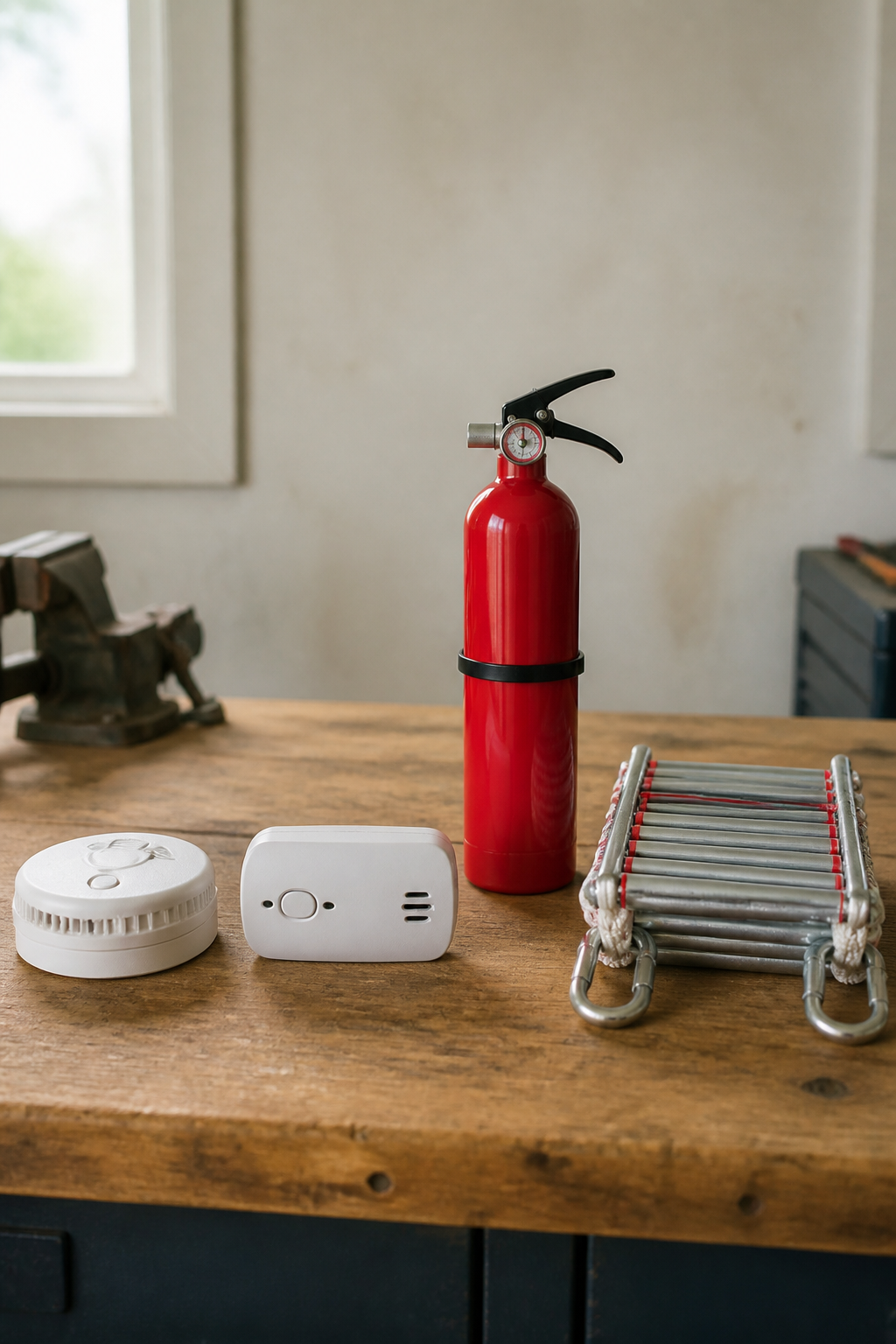
The whole set, on one line each
| Device | What it actually does | Where it goes | Life |
|---|---|---|---|
| Smoke alarm | Detects combustion particles and wakes people | Every bedroom, outside each sleeping area, every level | 10 years from manufacture |
| Carbon monoxide alarm | Detects a gas nobody can sense, over time as well as concentration | Every level, outside sleeping areas, near fuel appliances | 5 to 10 years, model dependent |
| Heat alarm | Detects temperature or a fast rise in it | Garage, attic, furnace room, workshop, kitchen | 10 years typically |
| Fire extinguisher | Puts out a small, contained fire, once | Each level, kitchen near the exit, garage, car | 10 to 12 years disposable; rechargeables serviced yearly |
| Escape ladder | Turns an upstairs window into a second way out | Stored in the room it serves, not in a hall closet | Indefinite if undamaged; inspect yearly |
| Fire blanket | Smothers a small pan fire or clothing fire | Kitchen wall, near the exit | Replace after any use |
The three alarms are not interchangeable
This is the single most common misunderstanding, so it is worth stating flatly. A smoke alarm will not detect carbon monoxide. A carbon monoxide alarm will not detect smoke. A heat alarm detects neither until a fire is already substantial. Combination units exist and are useful, but they are combinations, not replacements, and the label on the back tells you which sensors are actually inside.
- Smoke alarms: how to test them, ionization against photoelectric, the ten year date and where each one goes.
- Carbon monoxide alarms: placement floor by floor, the symptoms of poisoning, and the two different responses when it sounds.
- Heat alarms: the garage, attic and furnace room, and why interconnection is the whole point.
The things that put fire out
Both of these are for a fire that is still small, and both assume everyone else is already leaving.
- Multipurpose extinguisher
- An A:B:C dry chemical unit covers ordinary combustibles, flammable liquids and live electrical equipment. The extinguisher page explains the ratings, the four conditions and the PASS technique.
- Fire blanket
- A sheet of woven glass fibre that smothers a small fire by cutting off air. Genuinely good for a pan on the hob and for clothing that has caught. Pull it out by the tabs, hold it in front of you as a shield, lay it over the pan rather than throwing it, and turn the heat off. One use only.
The things that get people out
- Escape ladder
- A portable ladder that hooks over a windowsill. Bought once, stored in the bedroom it serves, and rehearsed at least by deploying it. The escape plan page covers choosing and using one, including the weight rating and the storey limit.
- A torch by each bed
- Unglamorous and worth more than most gadgets. Smoke and a power cut arrive together, and a torch at floor level shows the way out when nothing else does.
- Marked meeting point
- Not equipment at all, but the piece most often missing. A fixed object in front of the house that everyone can name and see from the street.
If the budget is small, in this order
- Smoke alarms in every bedroom and outside every sleeping area. Nothing else comes close for the money.
- A carbon monoxide alarm outside the sleeping area, if there is any fuel burning appliance, fireplace or attached garage in the building.
- A written escape plan and two drills a year. Free.
- One A:B:C extinguisher on the main floor, sited near an exit.
- An escape ladder for any occupied upstairs bedroom whose only other way out is the stairs.
- A heat alarm, interconnected, for the attached garage or workshop.
If the money is not there for the first item, the buying page explains how to find out whether your fire department or a local programme will supply and fit alarms at no cost. Many do, and asking costs a phone call.
Sold as safety equipment, but not
- Extinguisher balls and aerosol cans marketed as replacing an extinguisher. Some have no recognised listing and no verifiable rating. Treat anything without a rating on the label as a novelty.
- Smoke alarms with the battery already taken out by whoever lived there before you. Check on the day you move in, not in the spring.
- Decorative window security bars without a quick release. They stop burglars and they stop firefighters and they stop you. If bars are needed, they need an interior release that works in the dark.
- Alarms bought without a listing mark from an unfamiliar marketplace seller. How to read the mark and the date takes two minutes and is worth doing before you buy rather than after.